So, you’ve decided you want to become a police officer, correctional officer, sheriff, peace officer or another first responder.
You’ve started working out.
Maybe you’re running. Maybe you’re lifting weights. Maybe you’ve downloaded a random workout from Instagram and decided that doing 100 burpees a day is somehow going to prepare you for your future career.
We hate to break it to you…Being tired is not the same thing as being prepared.
A PARE, COPAT, POPAT, PFA or APREP is designed to challenge your ability to move, push, pull, climb, jump, change direction and keep working when your heart rate is high. These tests are much more specific to the job you are going to be doing than simply going for a run or spending an hour lifting weights.
And that’s why first responder fitness test training needs to be strategic. We’ve seen plenty of people who look incredibly fit walk into a fitness test and discover that the test is a completely different beast than they expected.
Here are the top five mistakes we see—and what you should do instead.
Mistake #1: Waiting Until You Have a Test Date
This is probably the biggest mistake and it’s DEFINITELY our biggest pet peeve!
Someone sees a job posting. They read that a PARE, COPAT, POPAT or APREP is required. They don’t know ANYTHING about any of these tests or what the require. They look at the deadline.
Then they say: “Okay, I guess I should probably figure this out and start training.” ????
Please don’t do this.
Fitness takes time to develop, MUCH MORE time than you think. Strength and Cardiovascular conditioning takes time. Movement efficiency and learning the course takes time. Trying to cram months of preparation into three or four days (or even weeks) isn’t the strategy you want.
Instead: Start Before You Need To
If a first responder career is your goal, start preparing before you have even applied!! Do your research and learn what fitness test will be required for the job that you want. Read up on the courses and their requirements, watch the YouTube videos, and learn the standards.
Even if you’re already relatively fit (which means you go to the gym regularly and do BOTH cardiovascular conditioning sprint work and strength training – not that you walk 10,000 steps a day), getting familiar with the test and identifying your weaknesses early gives you a massive advantage.
And if you’re starting from a lower fitness level or no fitness level at all?
Even more reason to start early. You don’t need to be “fit enough” before you begin, you just need to begin.
Mistake #2: Ignoring Cardio Until the Last Minute
But “I HATE cardio – I like to lift big heavy things” —- or “Oh, I’ll work on my cardio closer to the test.”
Famous last words. One of the biggest problems we see is applicants who are strong enough to handle the physical components like the weighted bag or the Push/Pull Machine, but they don’t have any of the cardiovascular conditioning to maintain their performance throughout the entire test and still have gas to move those heavy things when they need to.
These tests are designed to elevate your heart rate to the highest it can go. Then they ask you to keep working…. And working…. And working. That’s the point…. Your cardiovascular system needs to recover quickly between efforts while your muscles continue producing force when you are involved in an emergency situation that WILL arise while you are on the job.
Instead: Train Your Engine
Your program should include a combination of:
- Steady-state cardiovascular training
- Intervals
- Sprint work
- Stair work
- Circuit training
- Test-specific conditioning
You don’t need to destroy yourself every workout and in fact, you shouldn’t. You need progressive conditioning that allows your body to adapt without constantly running yourself into the ground. Don’t underestimate the importance of recovery too! A fitter body isn’t just one that can work hard, it’s one that can recover and go again.
Mistake #3: Only Practicing the Easy Stuff
We allllllll do this … The things we love and are easy for us are easy to keep doing, so we keep doing them. You might be crushing your gym workouts. You’re doing squats and lunges. You’re running, LOTS. You’re lifting heavy and feeling strong.
Then you show up for the actual test and suddenly realize: “Wait… I’ve never actually done THIS before.”
That’s a problem. A BIG problem!
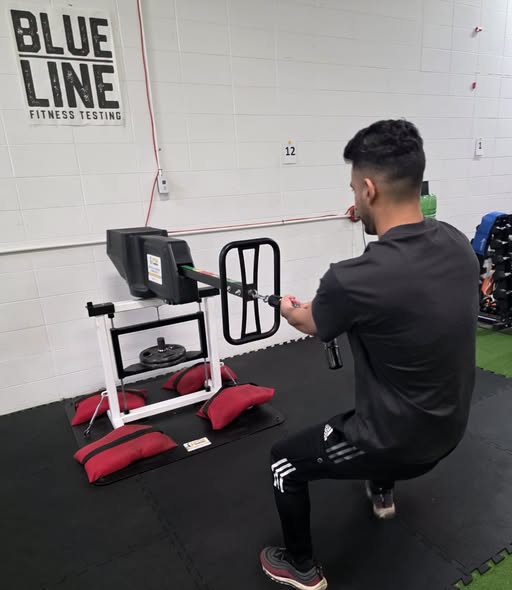
First Responder fitness tests have specific movements and equipment related to the job you are going to be required to do. If you’ve never experienced them, there’s a learning curve, and it’s pretty steep!
Technique, efficiency and pacing matters more than you think it will. Familiarity with the course, it’s transition points and the part where your body will want to give up, and you will need to dig deep and push through, shouldn’t be learned on your test day.
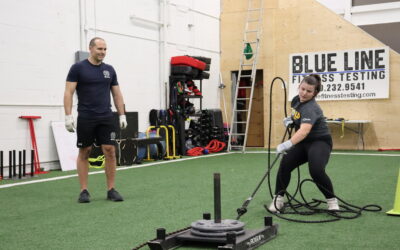
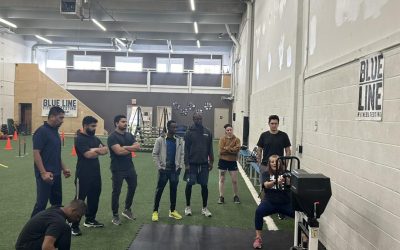
Confidence on test day matters and that’s why Blue Line Fitness Testing offers practice testing and test-specific training for PARE, COPAT, POPAT, PFA, WFX, Fire Fit and APREP, allowing applicants to become familiar with the actual testing environment and equipment.
Instead: Practice the Test
Don’t wait until test day to discover what the course feels like.
A practice run can help you identify:
- Where you’re losing time
- Which movements feel awkward
- Where your technique needs improvement
- Whether your pacing is appropriate
- Which physical areas need more work
And perhaps most importantly, it takes away some of the “WHAT THE HECK IS THIS?!” factor. You want the test to feel familiar—not like a surprise attack.
Mistake #4: Going Full Send Every Single Workout
We love motivation, hard work and watching people push themselves, but there’s a difference between training hard and training stupid. If every workout becomes a max-effort death march, you’re increasing the likelihood of excessive fatigue, poor movement quality and injury.
Your body needs time to recover and adapt and an injured applicant isn’t training, they’re sitting on the couch. Not exactly the career preparation strategy we’re going for.
Instead: Train With a Plan
Your training should have different intensities and purposes.
For example:
Strength day: Build force production.
Conditioning day: Improve cardiovascular capacity.
Interval day: Improve repeated high-intensity efforts.
Test-specific day: Practice movements and pacing.
Recovery day: Allow your body to actually recover.
Mistake #5:Training for “Fitness” Instead of Training for the Test
You can be strong AND fast. You can run a 5K in under 25mins and/or you can squat and bench a lot of weight.
And you can still struggle with your first responder fitness test.
Why? Because first responder fitness test training needs to prepare you for the specific demands of the test.
For example, running five kilometres continuously doesn’t necessarily prepare you for repeatedly sprinting, changing direction, climbing stairs and moving through obstacles with minimal recovery. Similarly, spending your entire workout lifting weights doesn’t teach your body how to perform strength movements while your cardiovascular system is already working hard.
Specificity matters. Your training should include movements and energy systems that closely resemble the test you’re preparing for.
Instead:
Find out exactly what your test involves. Understand the obstacles. Learn the movement standards. Understand the timing and transition points.
Then build your training around those demands. That’s a much smarter approach to first responder fitness test training than simply hoping your general fitness will carry you through.
Bonus Mistake: Assuming You Have to Do It Alone
You don’t!! YouTube is great (I may be a bit biased but Blue Line’s YouTube channel is amazing!) Instagram can have some fantastic fitness content and Blue Line does share tutorial videos every week!
And yes, you can absolutely make progress training on your own, but there is a difference between doing workouts and having someone assess what you actually need.
That’s where coaching can make a huge difference. At Blue Line Fitness Testing, we work specifically with people preparing for first responder fitness testing.
Our services include test-specific training, personal training, practice testing and workshops for applicants preparing for PARE, COPAT, POPAT, PFA, WFX, Fire Fit and APREP.
We can help you:
✔ Understand the test
✔ Identify your weaknesses
✔ Improve your conditioning
✔ Develop strength and endurance
✔ Learn efficient techniques
✔ Practice the actual movements
✔ Build confidence before test day
And perhaps most importantly, we’ll tell you what you actually need to work on instead of throwing another random workout at you.
The Bottom Line: Train Smarter, Not Just Harder
Your first responder fitness test day isn’t the time to find out whether your training worked. It should be the time when you show up and execute.
DON’T:
Rely on general fitness.
Ignore your cardio.
Wait until the last minute.
Avoid the test-specific movements or stuff you don’t like to do in the gym.
And don’t assume that destroying yourself in every workout is the same thing as effective training.
Instead, build a smart, progressive program that prepares you for the exact demands you’ll face, because first responder fitness test training isn’t about becoming the person who can survive one brutal workout. It’s about becoming the person who can walk into that testing facility, look at the course and think: “I’ve done this before. I know what I’m doing. Let’s go.”
Ready to start training?
Blue Line Fitness Testing helps first responder applicants prepare for PARE, COPAT, POPAT, PFA, WFX, Fire Fit and APREP with specialized training, practice testing and expert guidance.
Don’t wait for the test date to start getting ready.
Start training now. Show up prepared. And give yourself the best possible chance to pass the first time.
For more information on any of the first responder fitness testing Blue Line offers, check out these other pages and posts:
THE IMPORTANCE OF BEING PREPARED: 5 TIPS FOR EXCELLING IN LAW ENFORCEMENT FITNESS TESTS
TOP 10 EXERCISES TO ACE YOUR PARE OR COPAT TEST
How the Pass the PARE in Alberta
Sirens, Slammers and Service – A podcast for first responders