Thinking about becoming a firefighter in Alberta? Whether your goal is to join Edmonton Fire Rescue Services, Calgary Fire Department, Strathcona County Emergency Services or another municipal department, you’re looking at a career that demands far more than physical strength.
Firefighters need cardiovascular endurance, functional strength, problem-solving skills, teamwork, resilience and the ability to perform under pressure. Getting hired also requires preparation for an extremely competitive recruitment process, which can include aptitude testing, interviews, physical assessments, medical evaluations and specific education or certification requirements.
The good news? You can start preparing before you ever submit an application.
If you’ve been researching how to become a firefighter in Alberta, this guide will help you understand the steps involved, the differences between firefighter fitness tests and how to start building the fitness you’ll need to succeed.
Let’s get you moving toward that goal!
Step 1: Decide Where You Want to Become a Firefighter
Your first step is to identify the fire department or departments you’re interested in joining.
Although firefighters share many responsibilities, recruitment requirements can differ between municipalities. Don’t assume that passing one department’s fitness test automatically qualifies you for another. Some municipaliites also have different requirements for medical training or are dual purpose departments, meaning you need to be a Paramedic as well as a Firefighter.
Here are three options to consider.
Edmonton Fire Rescue Services
The recruitment process for Edmonton Fire Rescue Services is highly competitive and comprehensive (usually there is over 1000 applicants), and consists of multiple stages. Candidates who successfully navigate through each stage of the process are placed on an eligibility list for potential selection as a firefighter. Advancement and placement on this list are determined by the applicant’s performance in each stage of the process.
stages of the recruitment process
Aptitude Test
Resume Review
Interviews
Ride-Along
Physical Fitness Test
Psychological Assessment
Eligibility List
Threshold Knowledge Test
Recruit Class / Medical
Applicants should review the City’s current eligibility criteria, required certifications and application deadlines. Interested individuals can submit their applications through the City of Edmonton careers site between January 1 and 31, each year, for potential recruitment classes which will be employed in the following year. If you have further questions about Edmonton Fire Rescue Services, the firefighter recruitment process, or firefighting in general, simply reach out to [email protected]
Calgary Fire Department
Calgary firefighters are highly motivated and compassionate people who have a passion for public safety and helping others when they need it most.
The Calgary Fire Department Recruitment Team is dedicated to guiding, supporting, and selecting the next generation of firefighters who value pride, professionalism, teamwork, and respect. They believe that finding the right people goes beyond a resume and are looking for individuals who demonstrate exceptional character, integrity, and have a genuine desire to serve their community. Calgary uses the Candidate Physical Ability Test (CPAT) as part of its firefighter recruitment process. Candidates should review the department’s current recruitment requirements, including its preparation opportunities and CPAT standards.
Strathcona County, St. Albert and other municipalities
Surrounding communities have their own recruitment processes and may require different qualifications, fitness assessments or certifications. For example, Strathcona County’s firefighter/paramedic recruitment has used the University of Alberta firefighter physical fitness test. Check the specific department’s requirements rather than relying on assumptions.
Official resources: Strathcona County recruitment and the City of St. Albert website.
Also consider whether you’re interested in a full-time career position, part-time or paid-on-call firefighting, or wildland firefighting. Each pathway can have different requirements and expectations.
Your first move: Choose your target department, read its current recruitment information and make a checklist of every requirement you need to meet.
Step 2: Check the Qualifications You Need
Before investing time and money in courses such as the NFPA 1001 course, which is the core professional certification standard for structural firefighters and covers entry-level and intermediate training for career and volunteer firefighters, make sure you understand your target department’s minimum requirements.
Depending on the municipality, these may include:
- A high school diploma or equivalent
- A valid driver’s licence and a satisfactory driving record
- A Class 3 driver’s licence with an air brake endorsement, either at application or before hiring
- First Aid and CPR certifications
- Advanced First Aid or other specific qualifications
- Medical clearance and background checks
- The ability to pass physical fitness assessments
Not every department requires the same qualifications at the same stage. Calgary, for example, lists Advanced First Aid and CPR at the Health Care Provider or Basic Life Support level among its pre-hire requirements. Edmonton has its own certification and licensing requirements. Always consult the current recruitment information before registering for courses.
A practical tip: Create a spreadsheet with your target departments, required certifications, application deadlines and fitness assessments. This makes it easier to see which qualifications overlap and what you still need to complete.
Step 3: Understand the Firefighter Fitness Test Differences
This is one of the most important parts of learning how to become a firefighter in Alberta and one of the hardest parts of the recruitment process for most applicants.
PRO TIP: Not all firefighter fitness tests are the same. Two of the most important assessments to understand are Edmonton’s University of Alberta firefighter physical fitness test and Calgary’s Candidate Physical Ability Test (CPAT).
They assess different things and require different preparation strategies.
Edmonton Fire Rescue Services uses a physical fitness test administered by the University of Alberta’s Faculty of Kinesiology, Sport and Recreation.
The assessment includes:
- An aerobic endurance treadmill test known as the VO2 max test.
- Six task-specific job simulation tests including an Equipment Carry (Rescue Tools Hold), Charged Hose Advance, Weighted Sled Pull (Equipment Hoist), Forcible Entry (Sledge Hammer), Victim Rescue (Dummy Drag) and Ladder Climb.
- Applicants must wear firefighting personal protective equipment weighing approximately 22 kg (50 lb) during the tests.
Candidates complete an orientation and walk-through of the job simulation tasks. The assessment is pass/fail, and applicants have a single opportunity to take the test during a recruitment cycle. The cost for the assessment is approximately $400.
Preparing for this assessment means developing cardiovascular endurance, functional strength, muscular endurance and the ability to perform demanding tasks while wearing additional weight.
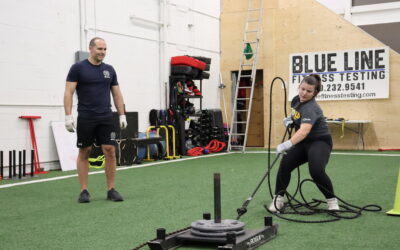
At Blue Line Fitness Testing, we can help you develop the physical capabilities these tasks demand through functional training, circuit work, strength conditioning and cardiovascular preparation.
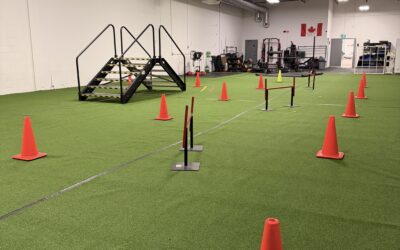
Our equipment and training environment allow you to practise relevant movements, work on transitions between tasks and identify areas that need improvement. Combined with a structured training plan found in our 6 week Fit For Fire course, this can help you approach your assessment with a better understanding of your capabilities and the work you still need to do.
Calgary: Candidate Physical Ability Test (CPAT)
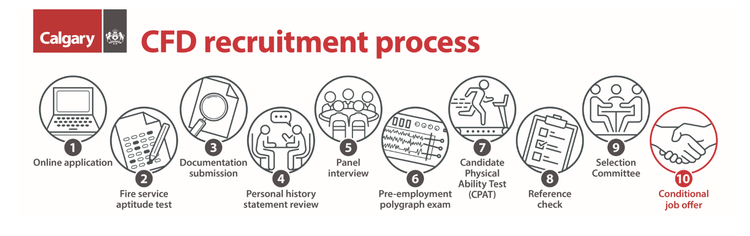
Calgary Fire Department uses the CPAT, a standardized physical ability assessment featuring eight stations designed to simulate firefighting tasks. It is the first pre-employment fitness assessment that will measure if applicants meet the minimum physical fitness requirements. It also tests your ability to perform essential tasks at emergency scenes. You will need to complete the CPAT if you reach Step 7 of the Firefighter Pre-Screening Process. Failure to complete the test will result in removal from the application process.
Importantly, Calgary also requires a separate treadmill assessment during the medical stage. This is a VO₂ test measuring oxygen use, with a stated minimum of 12 minutes and 30 seconds.
The CPAT and the treadmill assessment are separate assessments. Passing one does not mean you’ve completed the other and the CPAT requires a different preparation strategy from Edmonton’s firefighter fitness test. You need to understand the station sequence, develop the appropriate work capacity and practise the specific movements and equipment involved.
Blue Line offers access to specialized training equipment to help you prepare for the physical demands of the assessment. We can help you develop stair-climbing endurance, grip strength, loaded movement, pushing and pulling strength, and overall conditioning.
Strathcona County, St. Albert and Other Alberta Fire Departments
Planning to apply outside Edmonton or Calgary? Don’t assume every department uses the same test.
Strathcona County has used the University of Alberta firefighter physical fitness test in its recruitment process, while other municipalities may have their own physical assessments, standards or additional requirements.
Before you begin, check the current recruitment information for your target department. Once you know which assessment you need to complete, Blue Line can help you identify the relevant physical demands and develop a training strategy to match.Municipalities can establish their own recruitment requirements, and these can change between hiring competitions.
Wildland Firefighter Fitness Preparation
Interested in wildland firefighting? Your physical preparation may look different from that of a structural firefighter.
Depending on the position and employer, you may need to demonstrate sustained aerobic endurance, loaded hiking capacity, lower-body strength, muscular endurance and the ability to work in challenging terrain and environmental conditions.
Blue Line can help you build your conditioning through progressive cardio, interval training, functional strength work and circuits. Our monthly VO₂ Max testing sessions can also provide valuable insight into your aerobic fitness and help you track your progress.
Always check the specific physical assessment required by your wildland employer, as standards and testing protocols can vary.
Step 4: Prepare for More Than the Physical Test
Physical fitness is a major part of firefighting, but it isn’t the entire recruitment process. Depending on the department and recruitment competition, you may also encounter:
- Aptitude testing
- Resume and application screening
- Behavioural interviews
- Background and reference checks
- Medical assessments
- Psychological assessments
- Job-related knowledge or practical assessments
For example, Calgary’s recruitment process includes an aptitude test, an interview, a polygraph, the CPAT and subsequent selection and medical stages. Edmonton’s process includes aptitude testing, interviews and additional assessments for candidates who progress
Don’t leave these steps until the last minute.
Practise answering interview questions using the STAR method (Situation, Task, Action, Result). Gather your documents early. Research the department’s values and community responsibilities.
Fire departments are looking for people who can do the job, work effectively with a team, communicate clearly and make sound decisions under pressure. Your preparation should reflect all of those expectations.
Step 5: Get Professional Support With Your Firefighter Fitness Preparation
You can make progress on your own, but specialized coaching can help you identify weaknesses and train more effectively.
At Blue Line Fitness Testing in Edmonton, we help aspiring first responders build the physical fitness and confidence needed to pursue their careers.
Why Train at Blue Line Fitness Testing?
Here’s what sets us apart: we specialize in first responder fitness preparation.
Blue Line isn’t just another gym offering a generic workout. We understand that your goal is to meet a specific physical standard and prepare for a career where fitness matters. Our specialized facility in Edmonton gives applicants access to equipment for practising the assessments we support, along with coaching and training opportunities designed around first responder fitness demands.
At Blue Line, you can:
- Practise relevant test movements on the specialized equipment required in these fitness assessments.
- Build strength, cardiovascular endurance and muscular endurance.
- Identify weaknesses before your assessment.
- Improve technique, movement efficiency and pacing.
- Develop confidence through familiarization and structured practice.
- Get support choosing the right training approach for your target assessment.
Why wait until test day to discover what you need to work on?
Come in, practise, get feedback and build a plan. Our firefighter-focused training resources include:
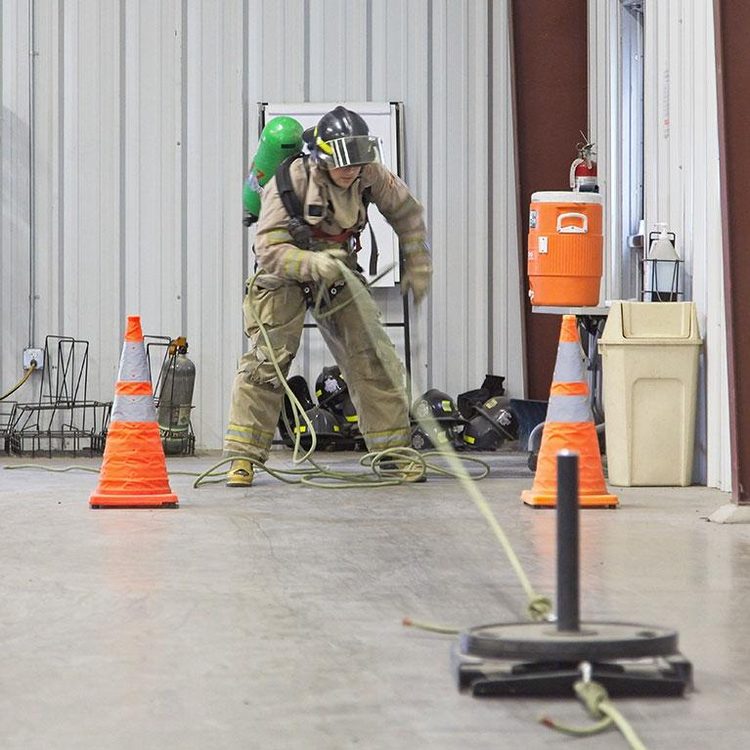
Firefighter fitness training
Build strength, cardiovascular conditioning and muscular endurance through functional exercises relevant to the physical demands of firefighting during our 6 week Fit for Fire course. Our 6-week Fit for Fire course is designed to help you build the strength, conditioning and functional fitness needed to pursue a firefighting career.
Over six weeks, you’ll work on developing the physical capabilities that matter for demanding firefighter assessments, with an emphasis on purposeful training and progressive improvement.
Whether you’re just starting your preparation or looking to take your fitness to the next level, Fit for Fire gives you a focused opportunity to work toward your goal alongside others who are pursuing the same career.
You’ll have a chance to challenge yourself, identify areas for improvement and develop better training habits that can carry beyond the course.

Fire Open Gym
Get hands-on practice with firefighter-focused movements and equipment while developing your physical capabilities. Contact us to confirm current sessions and available equipment.
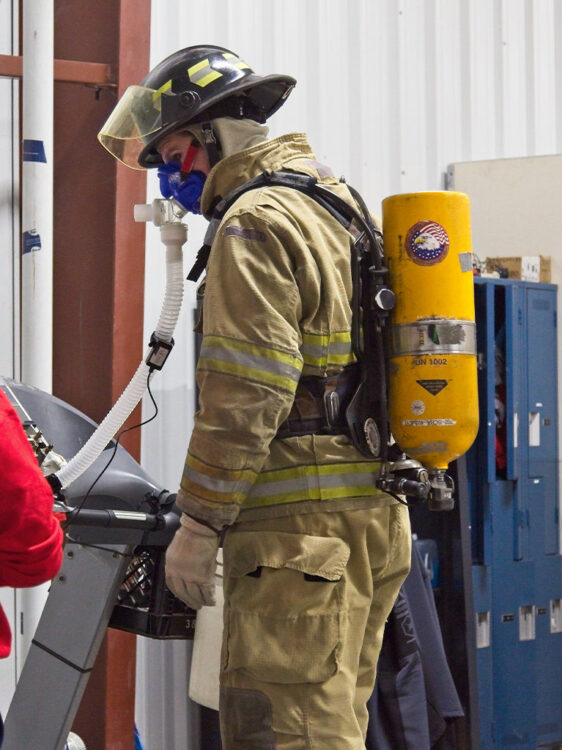
VO₂ Max testing
At Blue Line Fitness Testing, our monthly VO₂ Max testing sessions give you the opportunity to experience a demanding treadmill assessment BEFORE your official firefighter fitness test.
You’ll get a better understanding of what the physical challenge feels like, see how your body responds under pressure and identify areas where your cardiovascular fitness may need improvement.
Think of it as a chance to take the guesswork out of your preparation. Instead of wondering whether your cardio is ready, you can put it to the test, establish a baseline and use that information to guide your training.
Whether you’re preparing for Edmonton’s firefighter physical fitness assessment or working toward another first responder career, knowing what to expect can make a real difference in how confidently you approach test day.
Don’t wait until you’re wearing the gear and the clock is running to find out where your cardio stands.
Come experience the challenge, find out how you do and give yourself time to improve before it counts.

Personalized coaching
Get guidance on exercise technique, training priorities and progression based on your current fitness and goals by training with one of our personal trainers.
We understand that preparing for a career in emergency services can feel overwhelming, especially when you’re trying to figure out which test to train for, what equipment you’ll need and how to balance fitness with the rest of your life.
You don’t have to figure it all out alone.
Explore our services at Blue Line Fitness Testing and contact us to discuss the best starting point for your goals.
Step 6: Start Early and Stay Consistent
One of the best things you can do for your firefighter career is start preparing before a recruitment deadline appears.
A few weeks of frantic workouts aren’t a substitute for consistent training.
Give yourself time to improve your cardiovascular fitness, build strength, learn the required movements and address your weak points. If you’re new to exercise, have an injury or have a health condition, consult an appropriate healthcare professional before starting an intensive program.
A simple starting checklist:
- Identify your target department.
- Review the current recruitment requirements.
- Confirm which physical fitness test you need to complete.
- Check required education, licences and certifications.
- Establish your current fitness baseline.
- Create a progressive training plan.
- Practise the specific assessment where appropriate.
- Prepare your application and interview skills.
You don’t have to accomplish everything in one week. You just need a plan and the commitment to follow through.
Ready to Take the First Step Toward Becoming a Firefighter?
Learning how to become a firefighter in Alberta is about understanding the recruitment process, meeting the qualifications and preparing yourself for the physical and mental demands of the job.
Start by choosing your target department. Make sure you understand its specific fitness test. Build your strength and conditioning progressively, and give yourself enough time to practise before your assessment.
Whether you’re aiming for Edmonton Fire Rescue Services, Calgary Fire Department, Strathcona County, St. Albert or another Alberta fire service, preparation matters.
At Blue Line Fitness Testing, we’re here to help you build your fitness, develop confidence and take meaningful steps toward your first responder career.
Don’t wait until your test date is around the corner. Start preparing today.
Recruitment requirements can change. Always verify current qualifications, testing standards, fees and application deadlines directly with your target fire department before making plans.
For more information on any of the first responder fitness testing Blue Line offers, check out these pages and posts:
THE IMPORTANCE OF BEING PREPARED: 5 TIPS FOR EXCELLING IN LAW ENFORCEMENT FITNESS TESTS
TOP 10 EXERCISES TO ACE YOUR PARE OR COPAT TEST
How the Pass the PARE in Alberta
Sirens, Slammers and Service – A podcast for first responders